


⚡ Free Express Shipping in USA✦
🔥 Newest Arrival Collection Live Now✦
✨ SUBSCRIBE TO GET YOUR 10% Off✦

Last Updated: October 21, 2026
A car seat gap organizer is a storage container designed to fit between the driver or passenger seat and the center console. It captures items that typically fall into the gap during daily driving, phones, keys, coins, cards, and small essentials that would otherwise become inaccessible or create distractions.
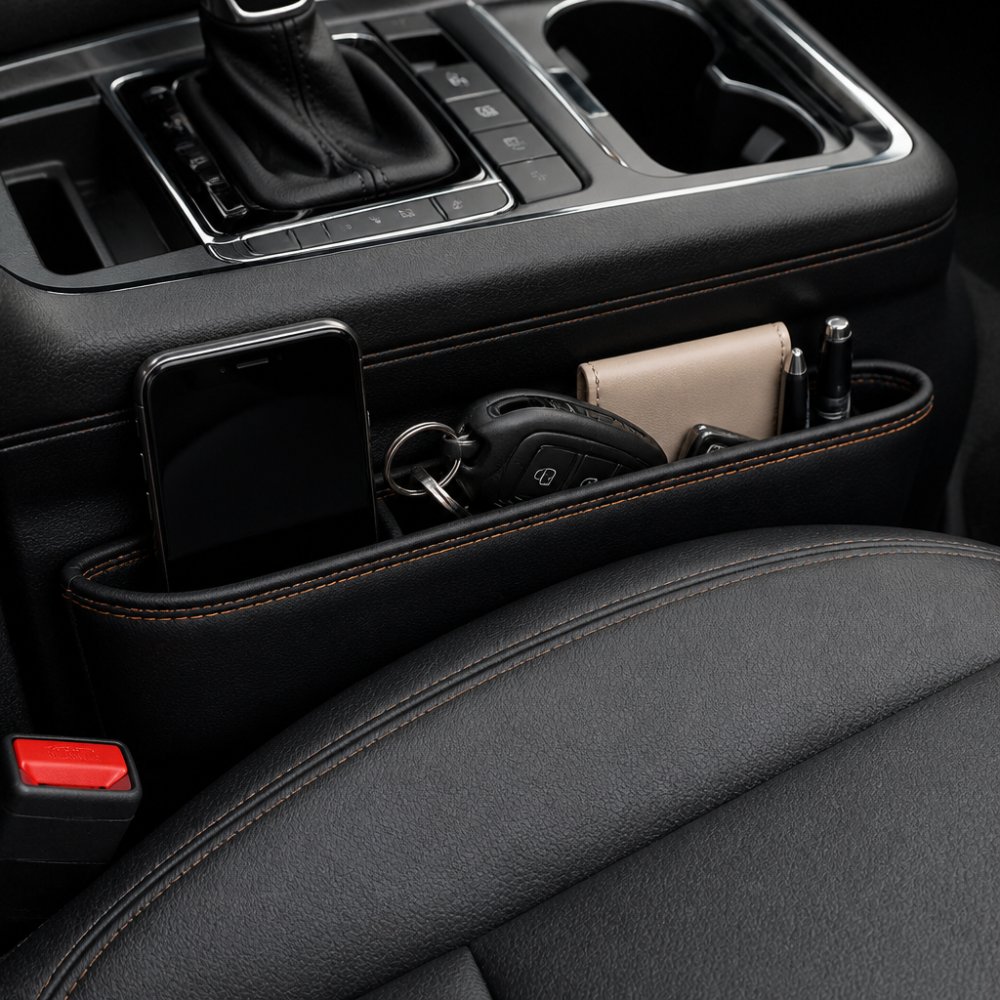
For commuters, this gap represents a real problem. The space between the seat and console is deep enough to swallow items but too narrow to reach easily while driving. A phone that drops into the gap forces a driver to take their eyes off the road or pull over to retrieve it. Keys and credit cards disappear into darkness. The gap organizer solves this by making the gap functional storage instead of a black hole.
The distinction between a gap organizer and a gap filler matters. A filler is a simple wedge that closes the gap entirely, it prevents items from falling but offers no storage. An organizer keeps the gap accessible while adding compartments, dividers, or a container structure to hold items securely. Most commuters benefit more from an organizer because it adds functionality without sacrificing the gap's natural depth.
Commuters face unique demands. They shift between their car, their desk, their home, and sometimes their phone. A car seat gap organizer keeps frequently used items within arm's reach during the commute, reducing fumbling and distraction. It also protects phones from damage by keeping them off the seat where they can slide, get sat on, or fall to the floor.
Fit is the most critical factor when choosing a car seat gap organizer, and it varies significantly across vehicle types. The gap width, depth, and shape differ between sedans, SUVs, trucks, and crossovers. An organizer that works perfectly in a Honda Civic may be too narrow for a Ford F-150 or too wide for a compact sedan.
Measure your gap before purchasing. Use a ruler or measuring tape to check the width at the narrowest point where the seat meets the console. Check the depth as well, how far back does the gap extend? Some gaps are only 2-3 inches deep, while others extend 6+ inches. A gap organizer should fit snugly without forcing or leaving excessive space.
Vehicle age and seat design also affect compatibility. Newer vehicles often have more sculpted seat bases and console designs, which can change the gap profile. Vehicles with adjustable seats or power seat adjustments may have different gap dimensions depending on where the seat is positioned. Test the organizer with your seat in its normal driving position.
Leather seats, fabric seats, and heated seats all sit slightly differently. Leather seats tend to be firmer and may sit closer to the console. Fabric seats sometimes compress more, creating a slightly wider gap. Heated seat bases can add thickness that affects fit. If your vehicle has any of these features, account for them when measuring.
Some organizers are universal, designed to fit gaps between roughly 2 and 4 inches wide. These offer flexibility but may not fit as securely as a vehicle-specific option. Vehicle-specific organizers are engineered for particular models or model years and typically offer better fit and stability.
Storage capacity should match what you actually carry during your commute. A minimalist commuter with just a phone and keys needs far less capacity than someone who also carries a wallet, sunglasses, charging cable, and a parking pass.
Most car seat gap organizers fall into two categories: simple single-chamber designs and multi-compartment layouts. A single chamber offers maximum flexibility, you can store items however they fit. Multi-compartment designs use dividers or separate slots to organize items by type. A typical layout might include a phone slot, a cup holder pocket, a coin tray, and a card slot.
Phone storage deserves particular attention. If your phone is your primary item, look for an organizer with a dedicated phone compartment that prevents it from sliding around. Some organizers include a rubberized or cushioned phone slot; others rely on a snug fit. A phone that moves during braking or acceleration becomes a distraction and a potential hazard.
Compartment depth matters for accessibility. Shallow compartments make items easy to grab while driving, but deep compartments may require reaching or looking down. Deep compartments protect items better and prevent them from being visible through the window, which can reduce theft risk. Consider your priorities, quick access or security.
Some organizers include a cup holder pocket or beverage slot. If you carry a travel mug or water bottle during your commute, this feature can be valuable. Others include a coin tray for tolls or parking meters, or a card slot for parking passes or transit cards.
Material choice affects how items feel inside the organizer. Soft materials like foam or felt are gentler on phones and prevent scratching. Hard plastic compartments are more durable but may require padding if you store delicate items. Leather or suede interiors feel premium and offer good grip for items.
Car seat gap filler installation varies depending on the organizer type, but most follow a similar process. Understanding installation before you buy helps you choose something you'll actually use rather than leaving in a box.
Most organizers either wedge into the gap, use adhesive backing, or rely on friction fit. Wedge-style organizers slide between the seat and console and stay in place through pressure. These are easiest to install, no tools or preparation needed. Slide it in, adjust it until it sits level, and you're done. Removal is equally simple: pull it out.
Adhesive-backed organizers stick to the console or seat base. Installation requires cleaning the surface first to remove dust and oils, then peeling the backing and pressing the organizer into place. Adhesive installation is more permanent and typically more secure, but removal can be difficult if you change your mind. If you're renting a vehicle or don't want to commit, adhesive-backed options may not be ideal.
Some organizers use a combination approach, adhesive on one side and a wedge design on the other. These offer the security of adhesive with some adjustability.
Before installing, clean the seat and console area where the organizer will sit. Dust, crumbs, and debris can prevent a secure fit or cause the organizer to shift. Use a small vacuum or brush to clear the gap.
Test the fit before fully committing. If it's a wedge style, slide it in and make sure it doesn't move when you push on it or adjust the seat. If it's adhesive, position it carefully before pressing down, adhesive is hard to reposition once it makes contact.
Removal is straightforward for wedge-style organizers. For adhesive-backed options, gently peel one corner and slowly work the organizer free. If adhesive residue remains, use a plastic scraper or your fingernail to remove it, or apply rubbing alcohol to soften the residue.
A phone is the most common item stored in a car seat gap organizer for phone use, and keeping it secure during driving is critical. A phone that shifts or falls becomes a distraction and a safety hazard.
Phone compartments in gap organizers typically use one of three approaches: a dedicated slot with side walls, a rubberized or textured surface that grips the phone, or a combination of both. A slot design physically prevents the phone from moving side to side. A textured surface relies on friction to hold the phone in place. The best designs combine both for maximum security.
Phone size matters. A gap organizer designed for standard-size phones may not hold a larger device securely, or it may be too tight for a smaller phone. Check the stated compatibility with your phone's dimensions before purchasing. If you use a phone case, account for the extra thickness, a cased phone is often 1/4 to 1/2 inch thicker than the bare device.
Angle and accessibility affect usability. Some organizers position the phone at an angle that makes it easy to see notifications or grab it quickly. Others lay the phone flat, which offers better stability but requires more reaching. Consider how you want to interact with your phone during your commute, do you glance at it frequently, or do you prefer to minimize distractions?
Charging cable management is often overlooked. If you charge your phone while driving, look for an organizer with a cable slot or routing channel that keeps the cable organized and prevents it from tangling or blocking access to the phone. A loose cable can become a distraction or a hazard.
Some organizers include a phone stand feature, a slot or lip that allows you to prop your phone up for GPS navigation or video calls. This can be valuable for long commutes or road trips where you use your phone as a navigation device.
The materials used in a car seat gap organizer determine how well it holds up over months and years of daily use. A commuter who uses the organizer five days a week, fifty weeks a year, puts significant wear on the product.
Common materials include rigid plastic, soft foam, leather, suede, and rubber. Rigid plastic is durable and easy to clean but can feel cheap and may not protect delicate items. Soft foam or felt provides cushioning and a premium feel but can compress over time and may trap dirt. Leather and suede offer durability and style but require occasional cleaning to maintain appearance.
Seams and joints are stress points where organizers often fail. Stitching should be tight and even. Glued joints should show no gaps or separation. If you notice loose stitching or gaps in the seams when examining a new organizer, it's a sign that durability may be compromised.
The base or mounting system determines long-term stability. Wedge-style organizers that rely on friction can loosen over time as the seat settles or as vibration from driving gradually shifts the organizer. Adhesive-backed organizers may lose grip if exposed to heat or if the adhesive quality is poor. Some organizers include reinforcement ribs or a contoured base that prevents shifting.
Cleaning and maintenance affect longevity. Organizers with smooth, sealed surfaces are easier to clean and resist staining. Organizers with porous materials like felt can trap dirt and may develop odors over time. If you carry food, drinks, or items that might spill, choose a material that resists staining and is easy to wipe clean.
Temperature extremes affect materials differently. Plastic can become brittle in cold weather or soft and warped in extreme heat. Leather can crack or fade. Adhesive can weaken in high heat. If you park in direct sunlight regularly or in cold climates, consider how the organizer's materials will respond over a year or two of exposure.
A well-constructed organizer from a reputable brand can last for years with normal use. The difference often comes down to material quality and construction attention.
Safety is non-negotiable when adding any item to your vehicle interior. A car seat gap organizer should never interfere with airbag deployment or create a projectile hazard in a collision.
Airbags deploy with tremendous force, often at over 200 mph. Any object in the path of an airbag can become a dangerous projectile. Most vehicle airbags deploy from the side of the seat or from the console area. A gap organizer that sits between the seat and console is potentially in an airbag deployment zone, depending on your vehicle's specific airbag system.
Before installing any organizer, consult your vehicle's owner manual to understand where airbags are located and how they deploy. Some vehicles have side-impact airbags that deploy from the seat itself. Others have airbags in the console area. Understanding your specific vehicle's system helps you choose an organizer that won't interfere.
Most quality gap organizers are designed with safety in mind, they're low-profile, lightweight, and positioned to minimize interference with airbag systems. However, this is something to verify, not assume. If a product doesn't clearly address airbag safety, contact the manufacturer before purchasing.
Weight and material matter for safety. A heavy organizer or one made of rigid material could cause injury if it becomes a projectile during a collision. Lightweight organizers made of soft materials are less likely to cause harm. Avoid organizers with sharp edges or hard corners that could concentrate impact force.
Distraction is also a safety issue. An organizer that requires reaching or looking down while driving increases distraction risk. The safest organizers keep items within easy reach and don't require taking your eyes off the road to access them.
Many commuters make predictable mistakes when selecting or using a car seat gap organizer. Avoiding these pitfalls improves the chance that you'll actually use the organizer and benefit from it.
The first mistake is buying without measuring. Assuming an organizer will fit because it worked for a friend or because it's labeled "universal" leads to poor fit and disappointment. A gap organizer that doesn't fit snugly will shift during driving, making it unreliable.
The second mistake is overloading the organizer. Just because a compartment exists doesn't mean you should fill it. An organizer packed with items becomes heavy, harder to access, and more likely to shift. Use it for your most-needed items, phone, keys, parking pass, and leave room for items to move slightly without spilling out.
The third mistake is ignoring maintenance. An organizer that collects dust, crumbs, and debris becomes a breeding ground for odors and can trap items that fall into crevices. Clean your organizer regularly, monthly or more often if you eat or drink in your car.
The fourth mistake is installing it incorrectly. A wedge-style organizer that's not pushed in far enough will shift. An adhesive organizer that's not pressed firmly enough will peel away. Taking time during installation prevents these issues.
The fifth mistake is choosing style over function. An organizer that looks great but doesn't fit your vehicle, doesn't hold your phone securely, or is too small for your needs will end up unused. Functionality should come first.
The sixth mistake is failing to test it before relying on it. Before you trust an organizer with your phone or keys during a commute, test it with weight and movement. Simulate braking and acceleration to see if items shift. This takes a few minutes and can save you from discovering a problem on the road.
The seventh mistake is placing items in a way that blocks your view or requires reaching. An organizer positioned too far back or too low can become a safety liability. Items should be within easy reach without taking your eyes off the road.
A car seat gap organizer solves a real problem for commuters, it keeps your essentials accessible and secure instead of lost in the gap between your seat and console. The right organizer depends on your vehicle's gap dimensions, what you carry, and how you want to organize your items. CarNook Co. offers car phone mounts and vehicle organization products designed to keep your essentials secure and within reach during your commute. Explore CarNook's collection to find accessories that complement your gap organizer and create a fully organized driving experience.
Most car seat gap organizers can hold phones, keys, coins, cards, and other small essentials. Storage capacity varies by model and design. Some feature dedicated phone holders or cup holders, while others offer open compartments. Check the product's compartment layout and dimensions to confirm it fits the items you carry daily during your commute.
Installation methods vary depending on the product design. Some use adhesive backing, others fit between the seat and console without tools, and some may use clips or fasteners. Always follow the manufacturer's installation instructions for your specific product. Most gap fillers are removable without causing damage when installed correctly, though adhesive-based options may require careful removal.
Many car seat gap organizers include phone holders or slots designed to keep phones secure during daily driving. However, security depends on the specific product design, phone size, and how well it fits in your vehicle. Some organizers work best with a phone case for added grip. Test the fit and stability before relying on it for highway driving or bumpy roads.
Car seat gap organizers fit most vehicles with front seats and a center console gap, but the fit varies significantly. Sedan and SUV gaps differ in width, depth, and angle. Measure your gap and check product compatibility before purchasing. Some organizers are adjustable or come in multiple sizes, while others are designed for specific vehicle types or seat configurations.

