


⚡ Free Express Shipping in USA✦
🔥 Newest Arrival Collection Live Now✦
✨ SUBSCRIBE TO GET YOUR 10% Off✦

Last Updated: October 6, 2026
For most daily commuters, a trunk organizer is worth it. It keeps groceries from rolling, holds emergency gear in one place, and cuts the time you spend digging around. This guide breaks down the cost-benefit math, what to store, and when to skip the purchase.
A trunk organizer is a container that sits in your cargo space and uses dividers and compartments to hold loose items in place. It does not add storage capacity, it makes the space you already have easier to use.
That distinction matters. Commuters often buy one expecting a transformation and end up with a box that slides around and holds three reusable bags. The difference comes down to fit, weight, and how you load it.
A trunk organizer solves one problem: loose items moving around while you drive.
Think about a normal commute. You stop for groceries on the way home, the bags tip over on the first turn, a water bottle rolls under the seat, and a jumper cable kit slides across the cargo space.
An organizer with dividers and a stable base limits that movement. Items stay in their compartments, and you grab what you need without unpacking the whole trunk.
What it does not do:
That last point trips up a lot of buyers.
The value of a trunk organizer depends on how often you carry loose items and how much time you lose to them. Commuters who stop for groceries, haul gym gear, or keep tools in the car typically get more use out of one than those who drive an empty trunk back and forth.
The honest math is about time and frustration, not money saved. Run this three-part test over one normal week:
If the answers are "most days," "several minutes," and "regularly," an organizer is usually easy to justify. If they are "rarely," "almost none," and "never," the benefit is small.
Daily commuters carry a different mix than road-trippers. These are the scenarios where an organizer tends to earn its place:
Most of these items move between home and work several times a week, that repetition is what separates a commuter's trunk from a road-tripper's.
Use these questions to decide whether the purchase makes sense for your routine:
| Question | Leans Toward Buying | Leans Toward Skipping |
|---|---|---|
| How often do you carry loose items? | Several times a week | Rarely or never |
| How much time do you lose to a messy trunk? | Noticeable each week | Almost none |
| Do you need the full cargo space often? | No | Yes, regularly |
| Do you already have bins or a net you like? | No | Yes |
| Is the clutter coming from the cabin, not the trunk? | No | Yes |
If most answers land on the left, an organizer is likely worth it. If most land on the right, your money may be better spent elsewhere, or on a smaller, simpler solution.
It helps to be clear about the limits:
If your main problem is a cluttered cabin rather than a cluttered trunk, a trunk organizer will not solve it. In that case, small cabin accessories, a phone mount, a console tray, or a crossbody phone case for the items you carry in and out, often make a bigger difference. CarNook Co. carries car phone mounts and crossbody phone cases that fit that kind of daily routine.
A commuter trunk should hold two categories of items: things you use often and things you hope never to need. Keeping them separate is the point of a divided organizer.
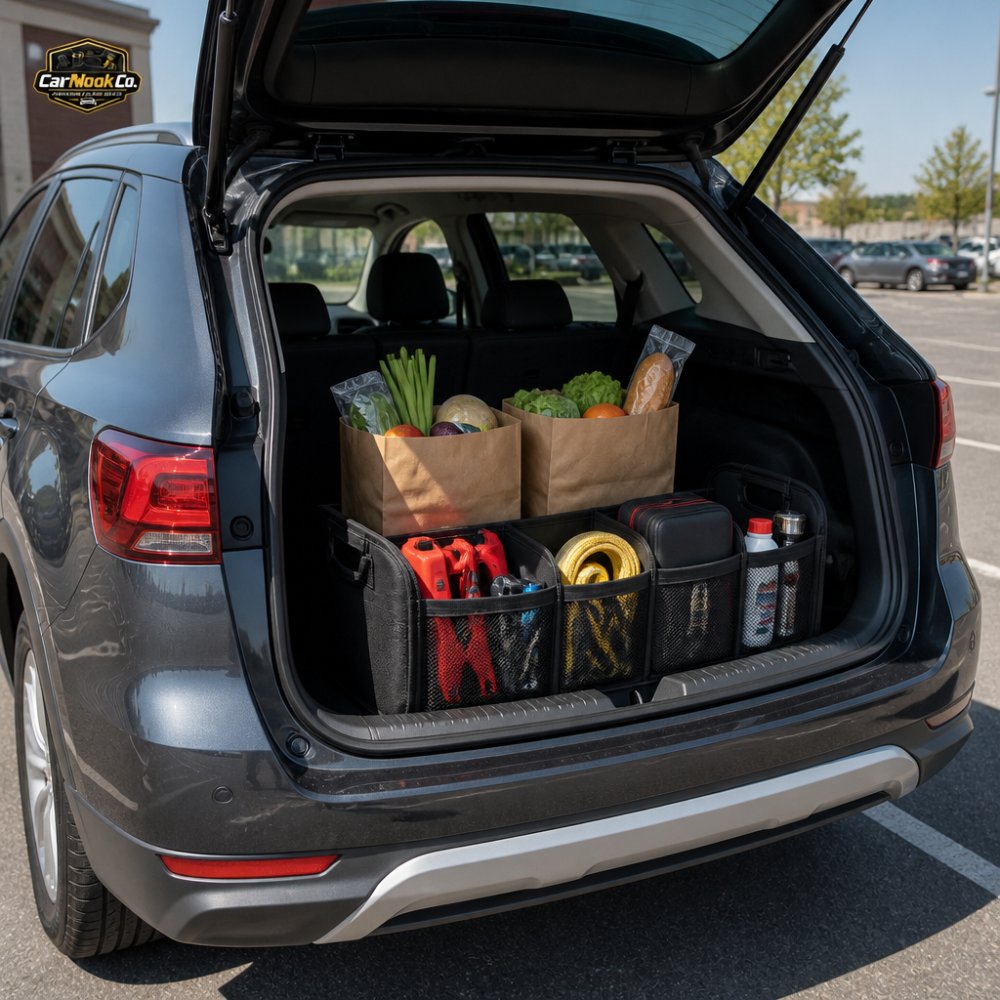
Everyday items are the ones you touch weekly; emergency gear is what you check twice a year and forget in between.
Everyday essentials:
Emergency and roadside gear:
Group these into separate compartments. Emergency gear goes in the compartment you rarely open so it stays clean and complete. Everyday items go up front where you can reach them.
A common mistake is mixing the two. When a flashlight ends up under a gym bag, you will not find it when you need it.
A sliding organizer is worse than no organizer. The fix comes down to three things: grip, anchoring, and weight.
The base matters more than the sides. A textured or rubberized bottom grips the trunk floor better than a smooth plastic one.
Options that help:
Check whether your vehicle has cargo tie-downs or a cargo net. Many sedans and SUVs include them, giving you a fixed point to secure the organizer.
There is no single best trunk organizer for every commuter. The right pick balances capacity that fits your trunk, durability that survives weekly loading, and foldability for the days you need the space back.
Fit is the most common reason a trunk organizer disappoints. Trunks narrow toward the back and the opening is often smaller than the floor, so a unit that looks right in a photo may not slide in.
A simple measuring routine:
Write those numbers down and compare them to the organizer's listed dimensions. If it is close to the opening width, it may not fit through even if it fits on the floor.
Capacity should match your cargo space, not exceed it. An organizer that fills the trunk leaves no room for larger items. A common pattern is to size it to roughly half the trunk floor so you keep flexibility.
Durability comes down to material and stitching. Look for reinforced handles, strong seams, and a base that holds its shape when loaded, a flimsy unit can collapse under weight.
Foldability matters if you sometimes haul bulky items. A collapsible organizer folds flat and stores out of the way when the trunk is needed for something else. Check how it folds, some units fold along rigid panels and hold their shape better over time than soft-sided ones.
Details worth checking before you buy:
You do not need a lab to judge whether an organizer is working. A few simple tests over the first week tell you most of what you need:
These are not pass/fail scores. They are a way to compare how a specific organizer behaves in your vehicle with your routine.
Fit is also about how the organizer interacts with the rest of your trunk:
Safety guidance from the National Highway Traffic Safety Administration stresses securing loose objects in your vehicle. An unsecured organizer loaded with tools can move in a hard stop. Use the manufacturer's recommended anchoring method when one is provided.
An organizer is not the only option. Depending on your trunk and routine, one of these may work better:
If you are unsure, start with the smallest option that solves your main problem.
For commuters who also want the cabin side of the routine tidier, small accessories can help. CarNook Co. offers phone stands and travel accessories that pair with an organized trunk setup.
Good trunk organization is about zones, not just containers. Divide your cargo space by how often you use each area.
Try this layout:
A few habits keep it working:
For drivers who rely on their phone for navigation, a secure mount up front keeps the cabin tidy and your device within reach. CarNook Co. carries car phone mounts and MagSafe-compatible accessories that pair well with an organized setup.
Fit and safety matter more than most buyers expect. An organizer that blocks your view or shifts in a crash is a problem, not a solution.
Check these before you buy:
Safety guidance from the National Highway Traffic Safety Administration stresses securing loose objects in your vehicle. An unsecured organizer loaded with tools can move in a hard stop. Use tie-downs or straps when your vehicle has them.
Also think about access. If you park in a garage or tight spot, a tall organizer can make loading and unloading harder. A lower, wider unit often works better for daily use.
A trunk organizer is not worth buying if your trunk is usually empty, you rarely carry loose items, or you need the full cargo space for large loads.
Skip it if:
There is also a case for waiting. If you are unsure what you carry, spend a week noting what ends up loose in your trunk. That list tells you whether an organizer would help and what size you need.
An organizer lasts longer with a little care. Most upkeep is about keeping it clean and stopping wear at the seams.
Simple habits:
If your organizer has removable dividers, take them out when you clean so you can reach the corners. For fabric units, let them dry fully before reloading if they get wet. Store the organizer flat when not in use, leaving a collapsible unit loaded and folded for months can weaken the creases over time.
Commuters who carry their phone, wallet, and keys between car and office often find that a crossbody phone case or a lanyard keeps those items off the trunk floor entirely. CarNook Co. offers crossbody phone cases and travel accessories built for that kind of daily movement.
Deciding whether a trunk organizer earns its place comes down to one question: do you carry loose items often enough to care? If grocery runs, gym gear, or roadside supplies regularly end up scattered, a divided organizer with a stable base can make your commute calmer and your cargo space easier to use. CarNook Co. offers practical car and travel accessories, including secure phone mounts, MagSafe-compatible accessories, phone stands, and crossbody cases, designed to keep your everyday essentials organized and within reach. Explore the CarNook Co. collection and find the accessories that fit your daily drive.
For many commuters, yes. A trunk organizer keeps grocery bags upright, stops loose items from sliding around turns, and gives emergency gear a fixed home. The value depends on how much you carry and how often. If your trunk stays empty except for a single bag, the benefit is smaller. If you juggle groceries, gym clothes, work supplies, and roadside gear, a trunk organizer typically earns its place by cutting clutter and preventing spills.
Focus on items you use weekly or need in an emergency. Common choices include a phone charger, jumper cables, a tire pressure gauge, a first aid kit, reusable grocery bags, an umbrella, and a change of clothes. Keep the most-used items in the front compartments for easy access. Store seasonal gear, like ice scrapers or sunscreen, in side pockets so they stay out of the way until needed.
Use dividers to create separate compartments so items cannot roll into each other. A non-slip base or grip mat under the organizer helps it stay put on the trunk floor. Distribute weight evenly, placing heavier items low and toward the center. Avoid stacking loose objects on top of the organizer. If your trunk has tie-down points, some organizers include straps or hooks that can anchor to them for added stability.
Look for organizers with a non-slip rubberized bottom, adjustable straps, or hook-and-loop strips that grip the trunk carpet. Rigid or semi-rigid side panels hold their shape better than soft fabric alone, which helps prevent tipping. Collapsible organizers with weighted bases can also stay in place. Whichever you choose, check that the base makes full contact with your trunk floor, since gaps let the organizer slide during turns.

