



Table of Contents
- What Makes a Car Mount Strong Enough for Heavy Phones
- Weight-to-Mount Ratio: The Spec Nobody Checks
- Magnetic vs. Mechanical Grip: Which Holds More Weight
- Quick Comparison: Heavy-Duty Mounts at a Glance
- 1. CarNook DashGrip Phone Mount: Best Dashboard Option for Heavy Phones
- 2. CarNook MagClip Phone Holder: Best Magnetic Pick for Large Phones
- 3. CarNook SecureRide Phone Mount: Best for Road Trips and Rough Terrain
- MagSafe Car Mount for Large Phones: What Actually Works
- How to Install a Car Phone Mount Securely
- Case Compatibility, Adhesive Wear, and Vehicle Limits
- Conclusion
- Frequently Asked Questions
Last Updated: September 17, 2026
What Makes a Car Mount Strong Enough for Heavy Phones
The best car mount for heavy phones is one built around grip strength, surface contact, and a mounting point that can carry real weight without sagging. Large phones push past what most vent clips and slim magnetic discs were designed to hold, and the failure usually shows up at the worst moment: a highway expansion joint, a hard brake, a pothole at speed. This guide from CarNook Co. breaks down the physics, the mounting styles, and the three CarNook mounts worth considering for heavy devices.
Weight is the variable most buyers ignore. A large phone in a protective case can weigh noticeably more than the bare handset, and every bump multiplies the load the mount has to absorb. That is why a mount rated for a light phone often works fine for a year and then starts drooping.
Below, we'll show exactly how to judge a mount before you buy, how each mounting style behaves under load, and how to install one so it stays put.
Weight-to-Mount Ratio: The Spec Nobody Checks
Weight-to-mount ratio is the relationship between how much your phone and case weigh and how much holding force the mount actually provides. A mount with a strong clamp but a weak arm will still fail, because the arm is the part that transfers force to the mounting surface.
Most product listings advertise grip strength and skip the arm entirely. In practice, the arm, the joint, and the surface contact point decide whether a heavy phone stays put.
Start With the Real Weight of Your Phone
A bare large-screen phone typically lands in the 6.5 to 8 ounce range, and a rugged protective case can add another 2 to 4 ounces. That means a "heavy phone" setup is often closer to 10 to 12 ounces than the number printed on the spec sheet. Every bump, brake, and pothole multiplies the load the mount has to absorb, so the mount is not just holding static weight, it is managing dynamic force.
A useful rule of thumb: the mount's rated holding force should exceed your phone-plus-case weight by a comfortable margin. If a listing does not state a weight rating at all, treat that as a warning sign for a heavy device.
The Four Specs That Actually Decide Holding Power
- Clamp or magnet rating: does the listing state what weight it holds? A rating in ounces or grams is more useful than vague words like "strong."
- Joint type: a ball-and-socket joint with a locking ring resists droop better than a friction-fit ball, because the ring mechanically locks the angle instead of relying on friction alone.
- Arm length: longer arms create more leverage against the base, so shorter is more stable. A short, rigid arm transfers far less vibration to the phone.
- Base footprint: a wider base spreads load across more of the dashboard or windshield, which reduces the chance of a slow slide or a sudden release.
A Simple Way to Compare Mounts
Before buying, write down three numbers: your phone-plus-case weight, the mount's stated weight rating, and the distance from the mounting surface to the phone. If the rating is close to your weight, or the distance is long, expect droop over time. If the rating is well above your weight and the arm is short, the mount has a real chance of holding a heavy phone through daily driving.
Magnetic vs. Mechanical Grip: Which Holds More Weight
Mechanical clamps generally hold more weight than magnetic mounts, because a spring-loaded clamp or locking arm physically wraps the device. Magnets rely on alignment and contact area, which works well for moderate weight but demands a compatible magnetic phone or case.
That does not make magnetic mounts the weaker choice across the board. A well-made magnetic holder with strong alignment is faster to use, easier to remove one-handed, and keeps the phone's screen unobstructed. The catch is that the magnetic connection only performs as designed when the phone or case is magnetic-compatible.
Quick Comparison: Heavy-Duty Mounts at a Glance
Mount |
Price |
Mounting Style |
Best For |
Standout Trait |
|---|---|---|---|---|
$24.99 |
Dashboard |
Everyday navigation |
Foldable, compact dashboard footprint |
|
CarNook MagClip Phone Holder |
$27.00 |
Magnetic |
Large magnetic-compatible phones |
One-hand attach and removal |
CarNook SecureRide Phone Mount |
$29.99 |
Handlebar clamp |
Road trips and rough terrain |
Aluminum alloy body, adjustable clamp |
Each option solves a different problem. The sections below explain which one fits which driver.

1. CarNook DashGrip Phone Mount: Best Dashboard Option for Heavy Phones
The CarNook DashGrip Phone Mount is the pick for drivers who want a heavy phone sitting low, close to the dash, and out of the windshield. It is a dashboard-mounted holder with an adjustable viewing angle, and it works with many smartphone sizes.
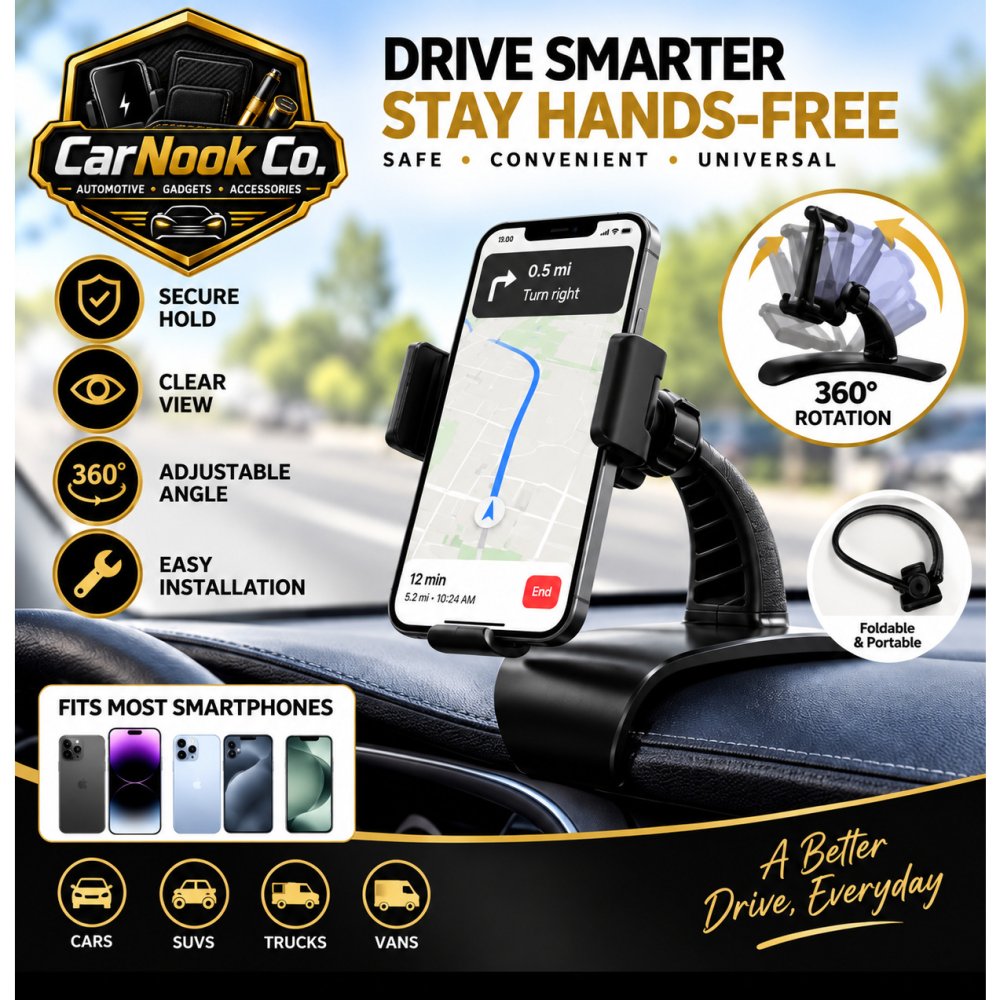
What makes it work for heavier devices is the placement. A dashboard mount keeps the phone's weight directly over a broad, flat surface instead of hanging off a vent slat or a thin arm. The foldable design also keeps the dashboard from looking cluttered when the mount is not in use.
Where it falls short: it is a non-powered holder, so there is no built-in charging. Drivers who want to top up while navigating will need a separate cable.
2. CarNook MagClip Phone Holder: Best Magnetic Pick for Large Phones
The CarNook MagClip Phone Holder suits drivers who mount and unmount constantly and want one-hand operation. It is a compact, low-profile magnetic holder made from ABS and silicone, and it works with compatible magnetic phones and cases.

The low-profile shape matters more than it sounds. A bulky magnetic mount can block part of the screen or crowd the dash, while a slim one keeps the phone stable and visible without dominating the interior.
The honest limitation: this is a universal magnetic holder, not a charger. It holds the phone; it does not power it.
3. CarNook SecureRide Phone Mount: Best for Road Trips and Rough Terrain
The CarNook SecureRide Phone Mount is built for vibration. It uses a strong aluminum alloy body and an adjustable clamp that fits phones roughly 55-100 mm wide and handlebars up to about 31.8 mm in diameter, which makes it a practical choice for bikes, e-bikes, and scooters as well as rough-road driving setups.

Aluminum alloy is the reason it handles rough terrain better than plastic-bodied holders. Metal resists the flex that plastic develops over time, and flex is what eventually loosens a clamp.
The trade-off is that this is a clamp-style mount, so it takes two hands to seat a phone rather than the one-hand snap of a magnetic holder. For long trips where the phone stays mounted for hours, that is a fair exchange.
MagSafe Car Mount for Large Phones: What Actually Works
A MagSafe car mount for large phones works when three things line up: a magnetic-compatible phone or case, a holder with strong magnetic alignment, and a mounting point that does not flex. Miss any one of those and the mount will feel unreliable regardless of price.
The most common mistake is buying a magnetic holder and pairing it with a case that was never designed for magnetic attachment. Alignment is not just about sticking; it is about centering the phone so the magnet's full contact area is engaged.
CarNook™ DashGrip Phone Mount →
For heavy phones specifically, keep the mount close to the base. A short, rigid connection between the magnet and the mounting surface transfers far less vibration than a long, jointed arm.
How to Install a Car Phone Mount Securely
Installing a car phone mount securely comes down to surface prep and clamp tension. Most mounts fail because of a dusty surface or an over-tightened clamp, not because the mount itself was defective.
Dashboard and Windshield Prep
Clean the mounting surface with an alcohol wipe and let it dry completely. Dust, dash protectant, and sunscreen residue all weaken adhesion, and a windshield suction cup will not hold on a greasy patch.
For adhesive bases, press firmly and let the pad cure before hanging the phone. Mounting the phone immediately puts the full weight on an adhesive that has not bonded yet.
Vent Clip and Adhesive Mounting Tips
Vent clips hold best on horizontal slats and worst on thin, angled ones. If the clip spins or slides, the slat is the problem, not the clip.
For adhesive mounts, avoid direct sun exposure on the pad. Heat softens adhesive and speeds up the slow slide that eventually drops a phone.
Case Compatibility, Adhesive Wear, and Vehicle Limits
Case compatibility is the single biggest cause of "my mount stopped working" complaints, and it rarely gets mentioned in product listings. A case that is too thick, too smooth, or not magnetic-compatible will undermine even a well-built holder.
How Case Thickness Affects Magnetic Strength
Magnetic holding force drops quickly as the distance between the magnet and the phone's magnetic array increases. A slim case might add only a millimeter or two, but a thick rugged case can add several millimeters of rubber, plastic, and air gap. That extra distance is enough to turn a secure hold into a phone that slides on hard turns.
A common pattern is that drivers blame the mount when the real issue is the case. If you use a thick protective case, look for a mount that either clamps mechanically or pairs with a magnetic-compatible case designed for attachment. Case compatibility is not a footnote, it is the first thing to check before relying on any magnetic mount for a heavy device.
Adhesive Degradation Over 12+ Months
Adhesive does not fail suddenly; it creeps. Over months of heat cycling, the pad slowly releases until one hot afternoon finishes the job. In hot climates, dashboard surface temperatures can climb well above ambient air temperature, and that heat softens the adhesive and speeds up the slow slide.
Drivers in hot climates should plan on replacing adhesive pads periodically rather than treating them as permanent. A practical habit is to check the pad at the start of each season: if the mount has shifted even slightly, replace the pad before it fails with the phone attached.
Vehicle-Specific Limits: Dashboard Texture and Vent Blade Shape
Not every vehicle gives you a flat, solid spot to mount. Curved dashboards, textured dash surfaces, and narrow vent slats all reduce the number of mounting points available.
- Dashboard texture: smooth, hard surfaces hold adhesive best. Soft, textured, or coated dashboards, common in many modern interiors, give adhesive less to grip, so a suction or adhesive mount may need a smooth adapter plate.
- Vent blade shape: horizontal slats hold vent clips best. Thin, angled, or vertical slats let the clip spin or slide, and the slat is usually the problem, not the clip.
- Windshield angle: a steeply raked windshield can put the phone far from the driver, which increases the leverage on the mount and makes a short, rigid arm more important.
Before buying, check that the mount's base actually has a flat, solid spot to sit on. If your dashboard is curved or heavily textured, a vent or windshield option may be the more reliable choice.
Case compatibility, adhesive wear, and vehicle limits are the three quiet reasons a heavy phone ends up on the floor mat.
Conclusion
Heavy phones expose every weak point in a mount: the joint, the arm, the adhesive, and the case. Choosing a mount rated for the weight, matching the mounting style to the interior, and installing it with clean surfaces and correct clamp tension solves most of it.
CarNook Co. builds mounts around those practical realities. The DashGrip Phone Mount keeps a heavy phone low and stable on the dashboard, the MagClip Phone Holder handles fast one-hand magnetic mounting, and the SecureRide Phone Mount brings an aluminum alloy clamp to rough terrain. Explore the CarNook car phone mount collection and pick the one that matches how you actually drive.
Frequently Asked Questions
What is the strongest phone holder for a car?
The strongest holders combine a mechanical clamp or a high-strength magnet with a rigid base. Dashboard and windshield mounts with suction cups and locking arms typically handle heavier phones better than vent clips, because the vent itself can flex under load. Look for aluminum or reinforced ABS construction, a ball-and-socket joint that tightens firmly, and a stated weight capacity above your phone's actual weight with a case attached. A mount rated close to your device's weight will sag over time.
Is MagSafe strong enough to hold a heavy phone in a car?
MagSafe magnets are strong enough for most phones if you use a compatible case or a magnetic ring, but heavy phones with thick cases can overwhelm weaker magnetic mounts. The key is magnetic alignment: the magnets must sit directly against the phone or a MagSafe-compatible case, not through a thick plastic shell. If your phone weighs well over 200 grams with a case, pair a magnetic holder with a mechanical backup or choose a clamp-style mount for rough roads.
How do I prevent my phone mount from sagging under weight?
Sagging usually comes from a loose ball-and-socket joint or a weak adhesive base. Tighten the joint screw or locking ring first. If the mount attaches with adhesive, clean the dashboard with an alcohol wipe and let it cure for 24 hours before mounting the phone. For very heavy devices, choose a dashboard mount with a wide base or a windshield suction mount, since both spread the load better than a narrow vent clip.
What features should I look for in a heavy-duty car phone mount?
Prioritize four things: a clamp mechanism or magnet rated for your phone's weight, a rigid mounting surface like a dashboard or windshield, a ball-and-socket joint that locks firmly, and materials that resist heat. Heat resistance matters because dashboard temperatures can soften cheap adhesives and plastics. Also check phone size compatibility, adjustable width, and whether the mount works with your existing case, so you do not need to buy a new one.
Will a heavy phone mount damage my dashboard or leave adhesive residue?
Suction and adhesive mounts can leave residue or pull up dashboard finish if removed carelessly. Warm the adhesive slightly with a hair dryer, then peel slowly at a low angle. Clean remaining residue with rubbing alcohol or a mild adhesive remover. To avoid damage altogether, use a mount with a reusable suction cup or place it on a smooth, flat dash seam rather than textured or painted surfaces. Vent clips avoid adhesive entirely but can stress vent slats.