



Table of Contents
- Why Heat Is the Real Enemy of Any Magnetic Phone Mount
- How to Keep Phone Mount From Falling Off in Heat
- MagSafe Car Mount Heat Tolerance: What the Specs Actually Mean
- Vent-Mounted vs. Dashboard-Mounted: Heat Performance Compared
- Adhesive Integrity and Temperature: When Glue Gives Up
- Magnetic Strength and N52 Ratings Under Heat
- Thermal Conductivity of Mount Materials
- Preventing Phone Overheating Alerts While Mounted
- Chemical Degradation of Adhesives Over Time
- EV-Specific Mounting Challenges
- Best Car Phone Mount for Road Trips: What to Look For
- Maintenance and Replacement Schedule
- Frequently Asked Questions
Last Updated: September 18, 2026
Why Heat Is the Real Enemy of Any Magnetic Phone Mount
A magnetic phone mount heat resistance guide matters because heat, not weight, is what kills most mounts. Adhesives soften, polymers creep, and magnets lose strength as cockpit temperatures climb well past what most drivers expect. This guide from CarNook Co. explains what actually fails, why it fails, and how to choose and install a mount that holds through a summer dashboard bake.

Most people assume a mount fails because the magnet is weak. That is rarely the story. The failure usually starts at the adhesive layer or the plastic housing, long before the magnet gives out.
Three things happen simultaneously when a car sits in the sun:
- The mounting surface expands and contracts with each heat cycle
- The adhesive softens and begins to flow under load
- The plastic housing loses rigidity and lets the phone shift
Each one is survivable on its own. Together, they compound. That is why a mount that held perfectly in April can drop a phone in July with no warning.
The sections below cover surface preparation, curing windows, N52 magnet ratings, material thermal conductivity, and the maintenance schedule that keeps a mount working past its first summer. The goal is simple: understand the physics, then install around it.
How to Keep Phone Mount From Falling Off in Heat
The answer to how to keep phone mount from falling off in heat is unglamorous: prepare the surface properly, respect the curing window, and reduce sustained load. Most failures trace back to skipping one of those three.

Adhesive bonding is a chemical process, not a mechanical one. The tape needs a clean, non-porous, room-temperature surface to form a full bond. Skip that, and the mount is already compromised before the first hot day.
Cleaning and Prepping the Mounting Surface
Surface preparation is where most installations fail. A dashboard carries a film of plasticizer, sunscreen residue, and dust that adhesive cannot bond through.
The reliable sequence:
- Wipe the target area with isopropyl alcohol and let it flash off completely
- Avoid textured or porous dashboard substrates, which reduce contact area
- Test-fit the mount before removing any backing liner
- Press firmly for 30 seconds once placed, working from the center outward
- Wait before adding the phone
Curing Time and First 24 Hours
Pressure-sensitive adhesive reaches roughly 50 percent of its final bond strength within an hour, and close to full strength after 24 to 72 hours at room temperature. Loading the mount immediately shortens its service life.
The practical rule: attach the mount, then leave it empty overnight. Add the phone the next morning. If the vehicle will sit in direct sun during that window, park in shade or use a sunshade.
Heat accelerates curing, but it also softens the adhesive prematurely. A mount installed on a 100-degree dashboard never gets the clean room-temperature cure it needs.
MagSafe Car Mount Heat Tolerance: What the Specs Actually Mean
MagSafe car mount heat tolerance is usually described in two separate numbers: the magnet's rated operating temperature and the adhesive's service range. Both matter, and they fail differently.
Magnet ratings typically cite a maximum operating temperature where holding force begins to drop. Adhesive ratings cite a range where the bond remains stable. A mount can have a strong magnet and a weak adhesive, and it will still fall.
Two specifications worth checking before purchase:
- Magnet grade and coating. N52 neodymium magnets hold the most per unit of size. A nickel-copper-nickel coating resists corrosion; bare or thinly coated magnets degrade faster in humid heat.
- Adhesive type. Acrylic foam tapes generally outperform rubber-based adhesives at sustained high temperatures. Rubber adhesives bond faster but soften sooner.
What most spec sheets leave out is the interaction between the two. A mount rated to 200°F for the magnet and 180°F for the adhesive is really a 180°F mount. The lower number governs.
Vent-Mounted vs. Dashboard-Mounted: Heat Performance Compared
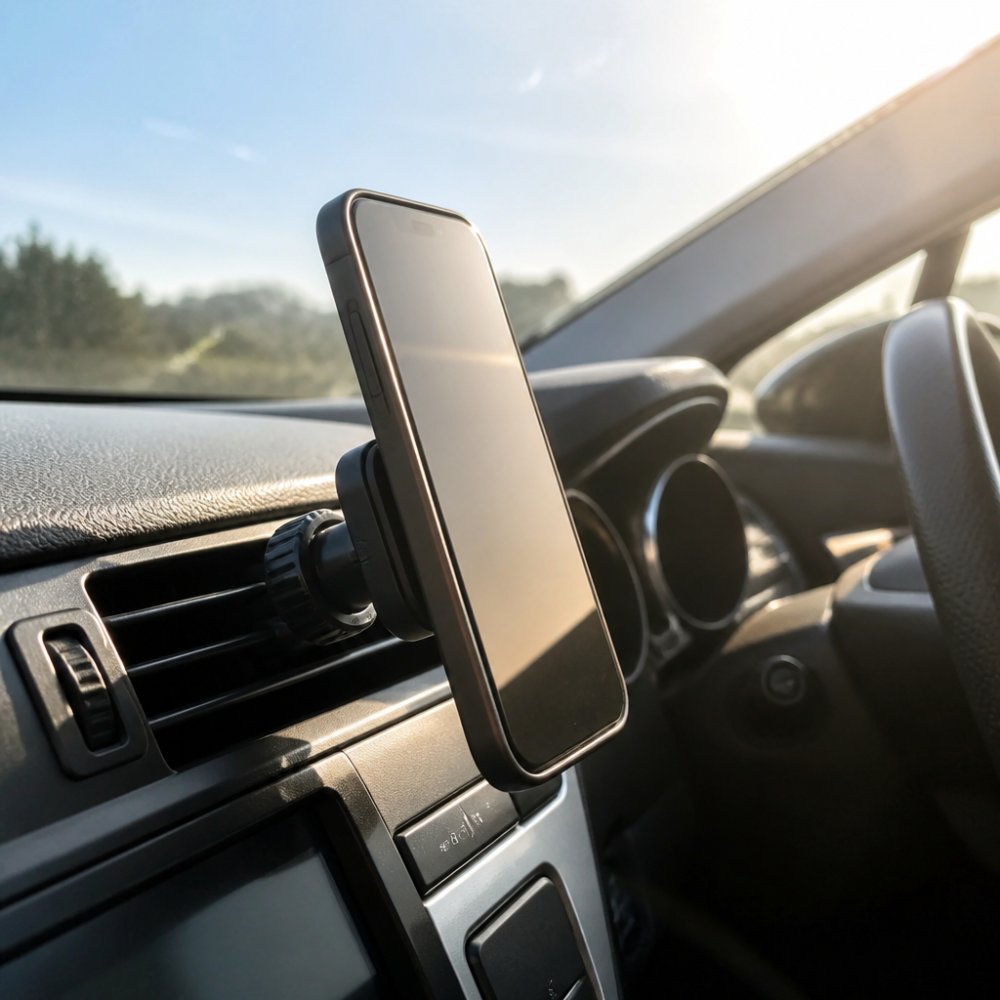
Vent-mounted and dashboard-mounted designs fail for opposite reasons, and the failure mechanisms are worth understanding before you pick one. Vent mounts get airflow, which keeps the phone cooler, but they inherit vibration and clip fatigue. Dashboard mounts sit in direct radiant heat but avoid clip stress.
Why the Two Types Fail Differently
A vent mount pulls conditioned air across the back of the phone. In summer, that airflow can drop the phone's surface temperature meaningfully during a drive. The trade-off is mechanical: vent louvers flex, clips loosen, and the mount develops play over time. The clip is usually the first thing to go, not the magnet.
Dashboard mounts trade airflow for stability. The phone sits still, but it also sits in the hottest zone in the cabin. A dark dashboard in full sun can reach temperatures that far exceed ambient air temperature, and the mount absorbs that heat directly. The adhesive layer is usually the first thing to go here, because it is the component closest to the hot substrate.
The Parking Variable Most Guides Skip
The single biggest factor in mount survival is not the mount type. It is how long the vehicle sits parked in direct sun. A vent mount in a car that parks in a garage six days a week will outlast a dashboard mount in a car that parks on asphalt every day, even though the vent mount is the "cooler" design on paper.
A useful way to think about it: peak soak temperature matters more than average driving temperature. A mount that never sees above 100°F will last years. A mount that sees 150°F+ soak cycles several times a week will degrade in a single summer, regardless of design.
Matching Mount Type to Real Driving Patterns
| Mount Type | Heat Exposure | Airflow | Main Failure Mode | Best For |
|---|---|---|---|---|
| Vent-mounted | Moderate | Good | Clip fatigue, louver damage | Short commutes, AC-heavy driving, garage-parked vehicles |
| Dashboard-mounted | High | Poor | Adhesive release, polymer creep | Long drives, stable placement, shaded parking |
| Windshield suction | High | Moderate | Suction cup failure | Temporary use, rentals |
| CD-slot mounted | Moderate | Poor | Slot wear, vibration | Older vehicles without vents free |
Neither design is universally better. The right choice depends on how long the vehicle sits parked in sun and how much the driver relies on airflow.
A Third Option: Hybrid and Offset Mounts
Some mounts combine a short arm with a vent clip, positioning the phone slightly away from the louver so it gets airflow without stressing the vent. Others use a dashboard base with a vent-adjacent arm. These hybrids are worth considering if you want the thermal benefit of airflow without the mechanical wear of a direct clip. The trade-off is usually a bulkier footprint and more installation time.
Adhesive Integrity and Temperature: When Glue Gives Up
Adhesive integrity is a temperature story with a sharp threshold. Below a certain point, the bond is stable under load. Above it, the adhesive behaves like a slow-moving liquid and the mount creeps.
Pressure-sensitive adhesives have two relevant temperatures: the softening point and the shear failure point. The softening point is where the adhesive begins to deform under sustained load. The shear failure point is where it lets go entirely.
Heat cycles matter as much as peak temperature. A mount that experiences daily swings from 70°F to 140°F accumulates fatigue faster than one held at a steady 100°F. Each cycle stresses the bond interface.
What most guides miss is that adhesive failure is rarely sudden. It shows up first as a slight tilt, then as a slow slide, then as a full release. By the time the phone drops, the bond has been degrading for weeks.
Magnetic Strength and N52 Ratings Under Heat
Magnetic strength under heat follows a predictable curve, and N52 magnets handle it better than lower grades at room temperature, but worse at the top of the range. That trade-off is the single most misunderstood spec in the mount category, and most buying guides skip it entirely.
The Grade/Temperature Trade-Off Nobody Explains
Neodymium magnets are graded by their maximum energy product, expressed in "N" numbers. N52 is the strongest common grade. It also has the lowest maximum operating temperature of the standard grades, because the same alloy composition that boosts room-temperature strength reduces heat tolerance.
In practical terms: an N52 magnet holds more at 70°F than an N42 magnet of the same size. But above a grade-specific threshold, the N52 loses holding force faster. For a mount that lives on a hot dashboard, a slightly lower grade with a higher temperature rating can outperform an N52 in July even though it loses on paper in January.
Two Temperatures, Not One
Spec sheets often list a single "maximum operating temperature," but there are really two numbers that matter:
CarNook™ DashGrip Phone Mount →
- Maximum operating temperature. The point above which the magnet begins to lose holding force permanently. This is the number to compare across grades.
- Curie temperature. The point at which the magnet loses magnetization entirely. This is far above any dashboard temperature and is not a practical concern for mounts.
A mount rated to 176°F for the magnet is really telling you the holding force is stable up to that point. Above it, the magnet is on a curve, not a cliff, but the curve is steep.
How to Read a Mount Spec Sheet
Three specifications are worth checking before purchase:
- Magnet grade and coating. N52 neodymium magnets hold the most per unit of size. A nickel-copper-nickel coating resists corrosion; bare or thinly coated magnets degrade faster in humid heat.
- Adhesive type. Acrylic foam tapes generally outperform rubber-based adhesives at sustained high temperatures. Rubber adhesives bond faster but soften sooner.
- Rated operating temperature. If the spec sheet lists only one number, assume it is the lower of the magnet and adhesive ratings. That is the number that governs real-world performance.
What most spec sheets leave out is the interaction between the two. A mount rated to 200°F for the magnet and 180°F for the adhesive is really a 180°F mount. The lower number governs.
Alignment and Case Thickness Matter More Than Grade
Holding force also depends on alignment. A MagSafe alignment that is off-center reduces effective holding capacity even when the magnet itself is at full strength. Heat makes this worse, because thermal expansion can shift the phone slightly on the mount.
Three factors determine real-world holding force:
- Magnet grade and coating quality
- Alignment between the phone's magnet array and the mount
- Thickness of the phone case between the two
A thick case can cut holding force enough that a mount rated for a bare phone becomes marginal with a case installed. That is a compatibility question, not a magnet question. If you run a thick case, look for a mount with a stronger magnet array or a mechanical retention feature rather than chasing a higher grade number.
Thermal Conductivity of Mount Materials
Thermal conductivity decides how fast heat moves from the dashboard into the mount and then into the phone. Materials with low conductivity act as insulators and slow the transfer; metals move heat quickly.
This is the angle most buying guides skip. A metal-bodied mount feels premium, but it also conducts dashboard heat straight into the phone's back panel. A plastic or silicone-bodied mount insulates, keeping the phone cooler but trapping heat in the housing.
The practical trade-off:
- Aluminum and metal bodies: fast heat transfer, good structural rigidity, can run hot to the touch
- ABS plastic: low conductivity, moderate rigidity, can soften at high temperatures
- Silicone and rubber grips: excellent insulation, high friction, degrade with UV exposure
For most drivers, a plastic or composite body with a silicone grip surface balances heat management and grip. Metal makes sense where structural rigidity matters more than thermal isolation.
Preventing Phone Overheating Alerts While Mounted
Device overheating alerts appear when the phone's internal temperature crosses a threshold and the operating system throttles performance. Mounting position and mount material both influence how quickly that happens.
Modern phones throttle aggressively in heat. The screen dims, charging slows or stops, and navigation apps can stutter. None of that is a mount defect, but the mount can make it worse.
Practical steps to reduce overheating while mounted:
- Position the mount away from direct sun and out of the defroster path
- Avoid charging wirelessly while the phone is already hot
- Remove thick cases during long summer drives when charging
- Use a vent mount when the AC is running
- Park with a sunshade to reduce soak temperature
Chemical Degradation of Adhesives Over Time
Chemical degradation is the slow failure that no installation guide prevents. Adhesives break down through oxidation, UV exposure, and plasticizer migration from the dashboard itself.
Dashboard plastics release plasticizers over time, especially in heat. Those compounds migrate into the adhesive layer and soften it from the inside. This is why a mount can hold for a year and then fail with no change in installation or usage.
UV exposure adds another path. Ultraviolet light breaks polymer chains in both the adhesive and the plastic housing. The damage is cumulative and irreversible.
Signs that chemical degradation has started:
- The mount tilts slightly under load but holds
- The adhesive surface looks glossy or has visible flow lines
- The housing feels softer or more flexible than when new
- The mount leaves residue when removed
Once these appear, the mount is on borrowed time. Replacement is cheaper than a dropped phone.
EV-Specific Mounting Challenges
Electric vehicles change the mounting equation in ways most guides ignore. Cabin heat profiles differ, dashboard materials differ, and the quiet cabin makes vibration more noticeable.
EVs often run cabin overheat protection, which keeps interior temperatures lower than a comparable gas vehicle when parked.
Three EV-specific considerations:
- Dashboard substrate. Many EVs use soft-touch or fabric-wrapped dashboards that adhesive struggles to bond to.
- Regenerative braking. The different deceleration profile changes the shear forces on a mount, particularly in stop-and-go traffic.
- Cabin materials. Low-VOC interior materials may release different compounds that interact with adhesive chemistry.
Best Car Phone Mount for Road Trips: What to Look For
The best car phone mount for road trips balances holding capacity, heat resistance, and adjustability across long days of driving. A mount that works for a 20-minute commute may not survive eight hours in a hot car.
What to prioritize:
- Adjustable viewing angle. Drivers change position and lighting throughout the day.
- Secure magnetic hold with a mechanical backup. Magnets alone can release in extreme heat.
- Compact, low-profile design. Less surface area means less heat absorption and less dashboard clutter.
- Case compatibility. The mount should work with the case already in use.
Maintenance and Replacement Schedule
Mounts are consumables, not permanent fixtures. A realistic maintenance schedule prevents the surprise failure that costs a phone.
A simple inspection routine:
- Monthly: check for tilt or play in the mount
- Monthly: wipe the mounting surface and adhesive interface
- Seasonally: inspect the adhesive for gloss or flow lines
- Seasonally: check the housing for softening or UV discoloration
- Annually: replace adhesive pads or the mount itself
- After any drop: inspect the mount before reuse
Frequently Asked Questions
Do magnetic phone mounts lose their strength in high heat?
Magnets themselves handle heat well, but the adhesives and plastics holding them can soften above 140°F. Once the adhesive weakens, the mount shifts and holding force drops. N52 magnets keep most of their pull up to roughly 176°F, so the magnet is rarely the failure point. The real risk is the mounting hardware and glue, which is why surface prep and curing time matter more than magnet grade alone.
Is MagSafe strong enough to hold a phone in a car?
Yes, when the mount uses a proper magnet array and the phone has MagSafe alignment. MagSafe car mount heat tolerance depends on the magnet ring staying aligned and the adhesive holding firm. In a hot car, a weak or misaligned mount can slip. Look for mounts rated for high ambient temperatures and clean the dashboard substrate with isopropyl alcohol before attaching.
What materials make a car phone mount heat-resistant?
Aluminum alloy, ABS plastic with high thermal resistance, and silicone grips hold up best. Aluminum spreads heat and resists warping, while silicone keeps its grip and adds vibration resistance. Avoid cheap all-plastic mounts that soften and lose holding capacity. Mounts with metal cores and silicone contact points maintain shear strength and mounting stability through repeated heat cycles.
How does direct sunlight affect magnetic phone mount adhesives?
UV degradation and heat cycles break down adhesive polymers over time. A dashboard can hit 160°F or more in summer sun, speeding up chemical degradation and causing suction cup failure or peel-off. Parking in shade, using a sunshade, and choosing a mount with thermal resistance ratings extends adhesive life. Replacing adhesive pads every 12 to 18 months is a practical habit.
What is the best way to prevent phone mount failure in hot weather?
Clean the mounting surface with isopropyl alcohol, let the adhesive cure for 24 hours before use, and avoid mounting directly over a hot vent or in direct sun. Check holding force monthly and re-tighten any hardware. For road trips, carry a backup mount and keep the phone out of direct sunlight to reduce device throttling and overheating alerts.
Are MagSafe mounts more heat-resistant than standard magnetic mounts?
Not automatically. MagSafe adds alignment and often stronger N52 magnet arrays, which helps holding force. But heat resistance still depends on the adhesive and materials. A well-built standard magnetic mount with aluminum and silicone can outperform a cheap MagSafe mount in high heat. Check temperature ratings and surface preparation, not just the MagSafe label.