



Table of Contents
- Why Suction Cup Mounts Fail in Extreme Heat
- Materials That Make Phone Mounts Heat-Resistant
- Best Mounting Locations for Heat Resistance
- Air Vent vs. Dashboard Mounts for Hot Weather
- Magnetic vs. Mechanical Grip Mechanisms in High Heat
- How to Keep Your Phone Cool in the Car
- Choosing the Best Car Phone Mount for Road Trips
- Maintenance and Summer Care for Durable Phone Mounts
- Conclusion
- Frequently Asked Questions
Last Updated: September 14, 2026
Why Suction Cup Mounts Fail in Extreme Heat
A suction cup mount fails in extreme heat because the seal between the cup and the surface breaks down. Heat softens the rubber, the trapped air pocket expands, and the vacuum that holds the mount in place weakens with every degree the cabin climbs.
The failure is gradual, which is what makes it dangerous. A mount does not pop off the moment the sun hits the windshield. It holds through the first twenty minutes of a drive, then releases somewhere on the highway.
Three forces work against a suction cup in a hot car:
- Thermal expansion. The air sealed inside the cup expands as temperatures rise, pushing outward against the rubber lip.
- Adhesive degradation. Many cups rely on a tacky coating to supplement the vacuum. Heat turns that coating greasy and slick.
- Surface flex. Dashboard materials expand and contract at different rates than glass, so the seal loses contact at the edges first.
A common mistake is blaming the mount for a problem that starts with the surface. Dust, dashboard protectant, and textured plastic all prevent a proper seal before heat ever enters the picture.
Materials That Make Phone Mounts Heat-Resistant
Materials determine how a mount behaves once the cabin heats up. Two categories matter most: the structural body and the gripping surface. Most guides stop at naming plastics and calling it a day. The useful question is why one material holds its grip at 150°F while another turns greasy and slides.
Heat-Stable Polymers and Silicone Bases
Heat-stable polymers are plastics engineered to hold their shape across wide temperature swings. Polycarbonate and glass-filled nylon are the two most common in automotive use, because both resist warping better than standard ABS plastic. The reason comes down to molecular structure: polycarbonate has bulky, rigid backbone groups that resist the segmental motion heat normally induces, and glass-filled nylon adds short glass fibers that lock the polymer chains in place. Standard ABS has neither, so it softens earlier and creeps under load, which is why a cheap cradle arm can sag by mid-summer.
Silicone bases outperform plain rubber for one reason: silicone keeps its flexibility at higher temperatures. Natural and SBR rubber stiffen and crack as heat drives off plasticizers; silicone's silicon-oxygen backbone is thermally stable and stays pliable, so it maintains contact with the mounting surface. That flexibility is what keeps a friction-fit or suction seal intact.
Heat-Resistant Adhesives and Gel-Based Suction
Gel-based suction uses a soft, tacky pad instead of a rigid cup. The gel conforms to slight surface imperfections, so it grips textured dashboards that a hard cup cannot seal against. The trade-off is that gel picks up dust and lint, which is why rinsing restores tack.
Heat-resistant adhesives work differently, and this is where the chemistry matters. Most pressure-sensitive adhesives are built on one of three polymer families:
- Acrylic-based adhesives hold up best in heat. Their glass transition temperature, the point where the adhesive softens and flows, is typically well above the temperatures a parked car reaches, so they stay firm and keep their bond.
- Rubber-based adhesives are tackier at room temperature but soften much earlier. In a hot cabin they flow, ooze, and lose cohesive strength, which is why rubber-based pads leave residue and slide.
- Silicone-based adhesives sit in between: they tolerate heat well but are less tacky, so they rely more on the mechanical grip of the pad itself.
The practical takeaway is that a mount advertised as "heat-resistant" should specify an acrylic or silicone adhesive, not a generic "strong adhesive." A rubber-based pad that feels stickier in the store is often the one that fails first in August.
How Heat Actually Reaches the Mount
It helps to separate two heat paths. Conductive heat travels through the dashboard or glass into the mount base. Radiant heat from sunlight hits the mount and phone directly. A dark dashboard can run far hotter than the surrounding air, so a mount rated for ambient temperature may still see surface temperatures well above that. This is why the same mount can perform differently on a black dashboard versus a light-colored one, and why location matters as much as material.
Best Mounting Locations for Heat Resistance
The best mounting location for heat resistance is a spot with shade and airflow: near a center air vent or low on the console, away from direct windshield exposure. Location affects temperature more than the mount itself does.
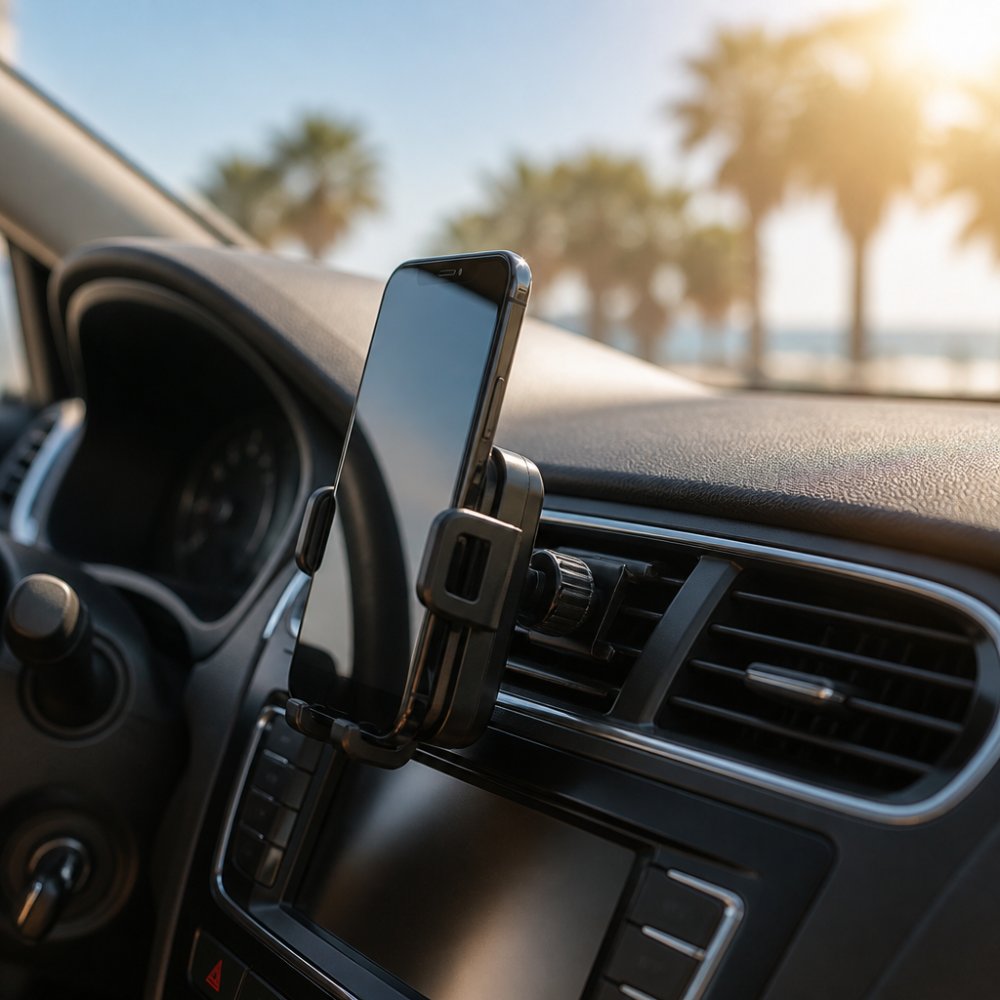
Windshield mounting puts the phone in the hottest zone in the car. Glass concentrates solar energy, and a phone sitting behind it absorbs that heat directly. A vent-adjacent position keeps the device in moving air and out of the direct path of sunlight.
Ranking the common spots by heat exposure:
| Location | Heat Exposure | Adhesion Risk | Best For |
|---|---|---|---|
| Windshield | Highest | High | Cooler climates |
| Dashboard top | High | High | Short commutes |
| Center vent | Moderate | Low | Summer driving |
| Console / lower dash | Lowest | Low | Year-round use |
Surface preparation matters as much as position. Wipe the area, check that the surface is flat enough for full contact, and avoid spots with heavy texture or curved edges.
Air Vent vs. Dashboard Mounts for Hot Weather
Vent clips and dashboard mounts solve different problems in hot weather, and the better choice depends on how the phone gets its airflow.
An air vent clip holds the phone in the path of conditioned air. That airflow does double duty: it cools the device and keeps the mount itself closer to cabin temperature rather than surface temperature. The limitation is mechanical. Vent louvers vary in thickness, and a loose clip vibrates.
Dashboard mounts offer a more stable platform and better viewing angles, but they sit in the hottest part of the interior. A dashboard mount with a heat-resistant adhesive or gel base can work well, provided the surface is prepared properly.
Magnetic vs. Mechanical Grip Mechanisms in High Heat
Magnetic and mechanical grips fail in different ways when temperatures climb, which makes the comparison less about strength and more about failure mode. The section most guides skip is what heat does to the phone itself once it is locked into either system.
How Magnets Behave in Heat
Magnetic mounts rely on a magnet array and a metal plate or a magnetic phone case. Heat does not meaningfully weaken the magnetic field of a neodymium magnet until temperatures approach its maximum operating range, which is far above anything a car cabin reaches. So the magnet itself is rarely the failure point.
What fails is everything around it:
- The adhesive holding the plate to the phone softens and lets the plate shift or peel.
- The adhesive or suction holding the mount to the surface gives out first, since it sees the highest surface temperatures.
- The phone case material can soften and allow the plate to migrate, which changes the alignment and weakens the hold.
A practical note on magnetic interference: a strong magnet near a phone can affect the internal compass, which matters if the phone is running navigation. Modern phones handle this well, but a poorly shielded mount can cause the map to rotate unexpectedly.
How Mechanical Grips Behave in Heat
Mechanical grips use clamping force: spring arms, a friction-fit cradle, or a locking mechanism. Heat affects the plastic and the spring tension. Cheap springs lose tension over time as the metal relaxes; better arms hold because the clamping force comes from the geometry of the cradle rather than a single spring. A cradle that grips by shape rather than by spring pressure is more heat-stable, because there is no stored tension to lose.
The Part Most Guides Miss: Heat Reaches the Phone Either Way
Whichever grip you choose, the phone is the component most sensitive to heat. A phone that gets too hot will dim its screen, slow its processor, and in some cases stop charging altogether to protect the battery. Running navigation in direct sun while plugged in accelerates that process, because charging generates its own heat on top of ambient and radiant heat.
This matters for battery health over time, not just for one hot drive. Lithium-ion batteries degrade faster when they are repeatedly held at high temperatures, and a phone mounted in direct sun with no airflow is one of the worst places to leave one. A magnetic mount that holds the phone flat against a dark dashboard traps heat against the back of the device. A mechanical cradle with an open back and a vent-adjacent position lets air move across the phone.
So the real comparison is not magnet versus clamp. It is how much heat each setup lets the phone shed:
| Factor | Magnetic Mount | Mechanical Cradle |
|---|---|---|
| Magnet strength in heat | Stable | Not applicable |
| Weak point | Plate adhesive, case material | Spring tension, plastic creep |
| Phone airflow | Often blocked by flat contact | Better if cradle is open-backed |
| Best paired with | Vent-adjacent position, MagSafe case | Vent-adjacent position, open cradle |
How to Keep Your Phone Cool in the Car
Keeping a phone cool in the car comes down to three things: shade, airflow, and reducing the work the phone is doing. Navigation plus charging plus a hot dashboard is the worst combination.
Device overheating is not just an inconvenience. A phone that gets too hot will dim its screen, slow its processor, and in some cases stop charging altogether to protect the battery. Running navigation in direct sun while plugged in accelerates that process.
Practical steps that help:
- Point a vent at the phone rather than away from it
- Unplug the charger if the phone is already hot; charging generates its own heat
- Lower screen brightness during long daytime drives
- Remove a thick case if the phone runs hot regularly
- Park in shade or use a windshield sunshade
Leaving a phone mounted on a sun-exposed windshield while the car sits parked is the fastest way to trigger a heat warning. The cabin can reach temperatures well above the outside air, and the phone absorbs that heat with no airflow to shed it.
Choosing the Best Car Phone Mount for Road Trips
The best car phone mount for road trips is one that stays put across changing surfaces, holds the phone at a usable angle, and does not add heat to the device. Long drives expose every weakness a mount has.
Road trips stress a mount in ways daily commuting does not. The phone stays mounted for hours. Temperatures swing from cool mornings to hot afternoons. The mount moves between cars, rental vehicles, and sometimes a bike or scooter.
What to prioritize:
- Adjustable articulation. A ball joint or 360-degree rotation lets the driver set the angle without fighting the mount.
- Secure grip across phone sizes. A cradle or clamp that fits a range of widths avoids a mid-trip replacement.
- Vibration dampening. Highway driving sends constant small shocks through the mount; dampening protects both the phone and the grip.
- Heat-tolerant materials. Silicone, polycarbonate, and aluminum alloy hold up better than generic plastic.
CarNook Co. builds its mount lineup around exactly this problem. The CarNook™ DashGrip Phone Mount is a compact dashboard design that keeps the phone within sight for navigation and hands-free use, and the CarNook™ SecureRide Phone Mount uses an aluminum alloy body with an adjustable fit for many phone sizes and handlebars, which suits riders and road trippers who move between vehicles.

For drivers who want one setup that travels well, a mount paired with a magnetic accessory or a protective case keeps the whole system consistent from car to car.
Maintenance and Summer Care for Durable Phone Mounts
Durable phone mounts stay durable only with a little upkeep. Summer maintenance is mostly about keeping the contact surfaces clean and the grip mechanism free of debris.
A simple routine covers most of it:
- Remove the mount and rinse a gel or suction base with warm water to restore tack.
- Wipe the mounting surface with isopropyl alcohol before reattaching.
- Check the ball joint and locking mechanism for play, and tighten if needed.
- Inspect silicone and rubber parts for cracking at the start of the season.
- Store spare mounts out of direct sun when not in use.
UV exposure is the slow killer. It breaks down rubber and fades plastic over a season or two, which is why a mount that worked fine in spring can fail by August. Rotating a mount out of the sun when parked extends its life noticeably.
Conclusion
Heat is the quiet enemy of every phone mount. Suction cups lose their seal, adhesives soften, and cheap plastics warp, and the failure usually shows up at the worst possible moment. Matching the mount to the surface, choosing heat-tolerant materials, and keeping the phone in airflow solves most of it.
CarNook Co. makes that easier with mounts designed for real driving conditions, including the compact CarNook™ DashGrip Phone Mount for dashboard navigation and the aluminum alloy CarNook™ SecureRide Phone Mount for riders and road trippers. Pair either with a MagSafe accessory or a protective case and the whole setup stays secure and cool.

Explore CarNook Co. mounts and accessories to build a setup that holds up all summer.
Frequently Asked Questions
Do suction cup phone mounts melt in high temperatures?
Suction cups rarely melt, but heat softens the rubber and breaks the vacuum seal, causing the mount to slip. Interior car temperatures can exceed 150°F in summer, which accelerates adhesive degradation and suction cup failure. Choosing mounts with silicone bases, heat-stable polymers, or gel-based suction helps them hold up. Parking in shade and using a sunshade also reduces the load on any durable phone mount.
How do I keep my phone from overheating while mounted in the car?
Position the mount so the phone sits in front of an air vent with unobstructed airflow, and avoid direct sun on the screen. Running the AC on low while charging helps with device cooling. Remove thick cases during long drives if your phone runs hot, and never leave it mounted on a sunny dashboard when parked. These habits protect battery health and keep navigation reliable.
Are air vent mounts better than dashboard mounts for hot weather?
Air vent mounts usually win in hot weather because moving air cools the phone and the clip avoids adhesive failure on hot plastic. Dashboard mounts offer a more stable view but sit in direct sun, which raises device temperature and stresses suction cups. For extreme heat, a vent-style mount paired with a heat-resistant clip is often the safer pick.
What should I look for in the best car phone mount for road trips?
Prioritize a locking mechanism or clamping force that survives vibration, a ball joint articulation for adjustable viewing, and materials rated for high heat like polycarbonate or aluminum alloy. A mount that works with your existing case saves money, and one that fits rental cars or multiple vehicles adds flexibility. Test the grip on a bumpy road before relying on it for a long trip.