



Table of Contents
- The Short Answer: Magnetic Mounts and Your Phone Battery
- How Magnetic Mounts Actually Work
- Why Magnets Don't Harm Lithium-Ion Batteries
- Do Magnets Affect Smartphone Sensors?
- MagSafe Charging Efficiency With Magnetic Mounts
- Myths vs. Facts: What You've Heard About Magnets and Phones
- Choosing a Safe Magnetic Mount for Your Phone
- The Bottom Line on Magnetic Mount Safety
- Frequently Asked Questions
Last Updated: September 5, 2026
The Short Answer: Magnetic Mounts and Your Phone Battery
The short answer is no: magnetic mounts do not damage your phone battery under normal use. Concerns about do magnetic mounts damage phone battery are common among drivers, and the worry is understandable. However, modern smartphones use lithium-ion batteries that are unaffected by the static magnetic fields produced by dashboard mounts and phone holders.
This guide from CarNook Co. breaks down the science behind magnetic mounting, what actually happens inside your phone, and which components you should think about. We will also separate the myths from the facts so you can choose an accessory with confidence.
The most important detail is that the magnets in phone mounts are static, meaning their field does not change. A static magnetic field does not generate heat or interfere with the chemical process inside a lithium-ion battery. That is the core reason your battery remains safe.
How Magnetic Mounts Actually Work
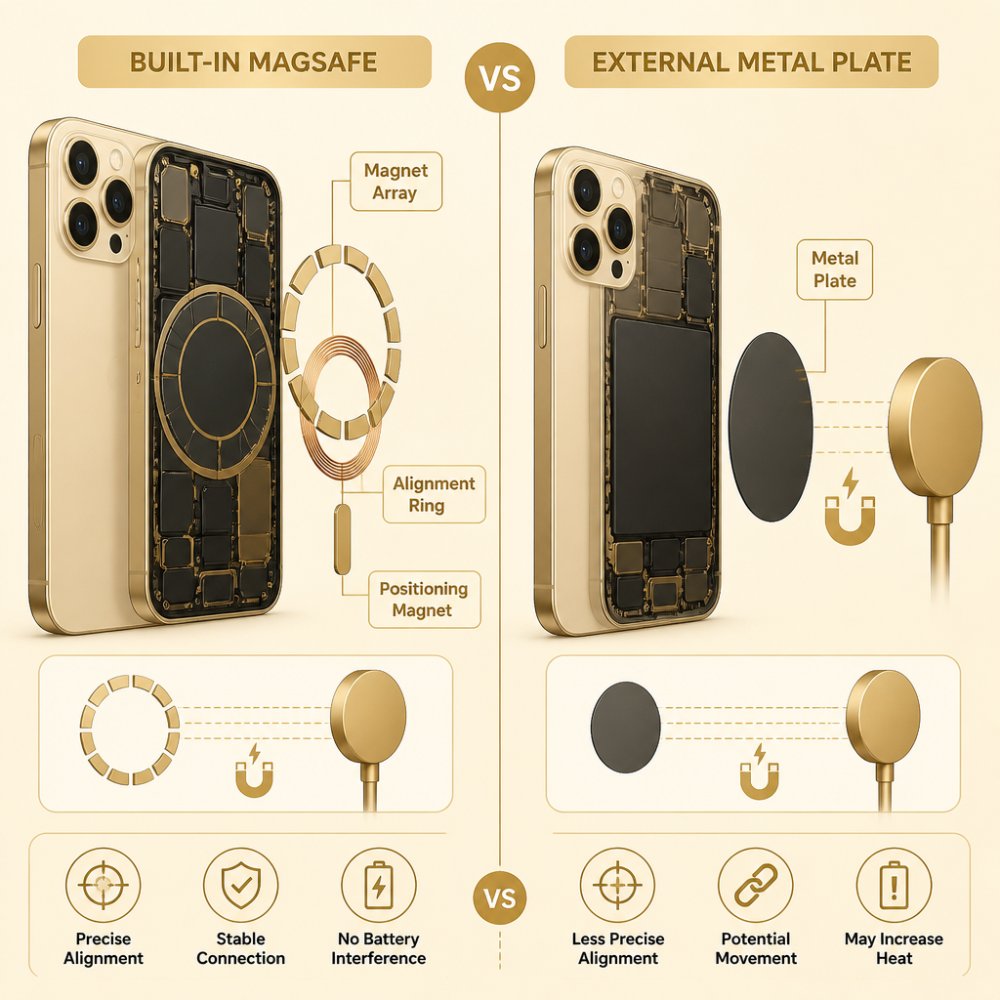
To understand the safety of magnetic mounts, it's essential to distinguish between the two main technologies on the market: Apple's proprietary MagSafe system and traditional adhesive metal plate mounts. They are not the same, and their interaction with your phone, and potential risks, differ significantly.
MagSafe and the Magnetic Alignment Array
MagSafe, introduced by Apple with the iPhone 12 lineup, uses a circular array of magnets embedded inside the phone's chassis, surrounding the wireless charging coil. This array is precisely engineered to align with the corresponding magnets in MagSafe-certified accessories, such as chargers and mounts. The magnetic field is strong enough to hold the phone securely but is carefully calibrated to not interfere with the phone's internal components or its wireless charging capabilities.
The key advantage of MagSafe is the built-in alignment. When you attach your phone to a MagSafe mount, the magnets snap into the correct position automatically, ensuring optimal wireless charging efficiency and a secure hold. This system is not just about holding the phone; it's about creating a standardized, safe interface for power and accessories.
Traditional Adhesive Metal Plates
Traditional magnetic mounts use a different approach. They consist of a magnet in the mount base and a thin, ferrous metal plate that you adhere to the back of your phone or inside a case. These plates are not standardized. Their size, shape, and magnetic properties can vary widely between manufacturers.
The primary concern with these plates is not the magnet in the mount, but the plate itself. A solid metal plate can interfere with wireless charging by physically blocking the electromagnetic field between the charging pad and the phone's receiver coil. This can lead to slower charging speeds, increased heat generation, and in some cases, the charging feature failing to work altogether.
Furthermore, the adhesive used on these plates can leave a sticky residue on your phone or case. Over time, this residue can attract dust and lint, which is unsightly and can be difficult to remove. More importantly, if you ever need to remove the plate, you risk pulling off the phone's oleophobic coating or, in rare cases, damaging the glass back.
A Critical Safety Distinction
For most users, both systems are safe for the battery. But for those concerned about wireless charging efficiency or who use medical devices, the choice between MagSafe and a traditional plate mount is a significant one. Choosing a mount that is MagSafe-compatible or uses a plate with a charging coil cutout is the best way to avoid these issues.
Why Magnets Don't Harm Lithium-Ion Batteries
A lithium-ion battery stores energy through chemical reactions. Charging and discharging move lithium ions between electrodes inside the battery. A static magnetic field does not create electrical current in the way an alternating field does, so it cannot disrupt this chemical process.
The physics here is worth understanding. Electromagnetic interference, or EMI, comes from changing fields that induce voltage in nearby conductors. Phone mounts produce a static magnetic field, not a fluctuating one. Without fluctuation, there is no induction and no effect on the battery's circuitry.
Heat is the real enemy of battery health, not magnets. Prolonged exposure to high temperatures degrades lithium-ion cells over time. If a phone sits on a sunny dashboard while using GPS, the heat from direct sunlight is a far greater threat to battery longevity than the magnetic mount holding it in place.
| Concern | Reality | Impact on Battery |
|---|---|---|
| Static magnetic field | Does not induce current | No impact |
| Heat from dashboard sun | Raises internal temperature | Accelerates degradation |
| Wireless charging heat | Mild warmth during charging | Minimal, normal wear |
| Magnetic flux density | Very low near phone | No effect |
Do Magnets Affect Smartphone Sensors?
While your battery is safe, magnetic mounts can affect more than just your phone's internal sensors. It's crucial to understand the impact on both your device's functionality and, more importantly, on your personal health if you rely on certain medical devices.
The Phone's Magnetometer: A Temporary Glitch
The most well-known effect is on the magnetometer, the sensor that powers your compass app. This sensor detects magnetic fields to determine direction. A strong nearby magnet, like the one in a mount, can temporarily saturate this sensor, causing your compass to point in the wrong direction.
The effect is almost always temporary. Once you remove the phone from the mount, the compass typically recalibrates on its own within a few moments. Most modern phones run a routine calibration when they detect inconsistent readings, which is why you occasionally see a prompt to move your phone in a figure-eight pattern. This is a minor inconvenience, not a sign of damage.
Other sensors are not vulnerable to static magnetic fields. The accelerometer and gyroscope measure motion, not magnetic fields. Camera systems with optical image stabilization, or OIS, use tiny magnets internally to move the lens, but the external field from a mount is not strong enough to disrupt that controlled mechanism.
The Critical Concern: Medical Implants
The most significant safety consideration regarding magnetic mounts is not for your phone, but for you. Many medical devices, including pacemakers and implantable cardioverter-defibrillators (ICDs), contain a reed switch that is activated by a magnetic field. This switch is designed to put the device into a specific mode, often for clinical evaluation.
A strong external magnet, like those found in some phone mounts, can inadvertently activate this switch. For a pacemaker, this could cause it to pace at a fixed rate, which may not be appropriate for the patient's current activity level. For an ICD, it could temporarily disable the delivery of life-saving shock therapy.
The Food and Drug Administration (FDA) and device manufacturers have published guidelines on this issue. A common and prudent recommendation is to maintain a distance of at least 6 inches between the magnet and the implant. This means that a magnetic mount on your car's dashboard, which is often less than 6 inches from your chest, could pose a risk.
Modern Shielding and Why It's Not Enough
You might wonder why modern smartphone shielding doesn't protect you. The shielding inside your phone is designed to protect the phone's internal electronics from external interference, not to contain the magnetic field of an external accessory. The magnetic field from a mount extends outward from the phone, and it is this external field that can interact with a medical implant.
This is a critical safety gap in many tech-focused articles. The conversation about magnetic mounts is often limited to battery health and compass accuracy, but for a significant portion of the population, the real question is one of personal safety.
For everyone else, the impact on your phone's sensors is a minor, temporary inconvenience. The phone's internal shielding is effective at protecting its own components, but it does not protect you from the external magnetic field. Understanding this distinction is the most important takeaway from this section.
MagSafe Charging Efficiency With Magnetic Mounts
MagSafe charging efficiency depends on proper alignment. The magnetic ring in the phone aligns perfectly with the charging coil in the accessory, which is actually an advantage. When coils align correctly, less energy is wasted as heat, and charging speeds stay at their rated level.
The key question is whether a magnetic mount interferes with wireless charging. A mount that places the phone correctly does not reduce charging efficiency. The magnets in the phone and the mount do not fight each other, they work together to hold the device in the optimal position.
Traditional metal plates can interfere with wireless charging. A solid ferrous metal plate sits between the charging pad and the phone's coil, blocking the electromagnetic field. If you use a traditional mount and also want wireless charging, look for a plate with a cutout in the center or use a MagSafe-compatible case instead.
Myths vs. Facts: What You've Heard About Magnets and Phones
Many myths about magnets and phones persist despite the evidence. One common claim is that a magnet will wipe your phone's data, which is false. Modern phones use flash storage, which is unaffected by magnetic fields. This myth dates back to the era of floppy disks and magnetic tape.
Another misconception is that magnets slowly damage internal components over time. Smartphone hardware is designed with shielding to protect sensitive electronics from electromagnetic interference. Internal components are also positioned away from the back surface where a mount attaches.
A third myth suggests that magnetic mounts cause GPS or signal strength problems. The GPS receiver and cellular antennas operate on radio frequencies that a static magnetic field does not disrupt. If you experience signal loss while driving, the cause is far more likely to be terrain, building density, or your carrier's coverage.
Choosing a Safe Magnetic Mount for Your Phone
Choosing a safe magnetic mount comes down to quality and design. Look for a mount with a strong neodymium magnet and a secure grip mechanism that holds the phone without slipping, especially on rough roads.
For iPhone users, a MagSafe-compatible mount offers the cleanest experience. The phone snaps into place without any added plate, and the alignment is always perfect. Android users can use a thin adhesive ring or a case with built-in magnetic compatibility.
CarNook Co. offers several practical options for drivers. The CarNook™ MagClip Phone Holder provides a compact, strong magnetic hold for quick one-hand attachment. For a dashboard setup, the CarNook™ DashGrip Phone Mount keeps your phone visible without taking up unnecessary space. Both work with the CarNook™ RidgeMag Leather Phone Case, which adds built-in magnetic compatibility and everyday drop protection in one package.


The Bottom Line on Magnetic Mount Safety
Magnetic mounts are safe for your phone battery. The static magnetic field they produce has no effect on lithium-ion chemistry, and the only component that might notice is the compass sensor, which recovers quickly. Heat and physical damage are the real threats to battery health, not magnets.
The decision comes down to choosing a well-made mount that holds your phone securely. A quality mount also protects your device from vibration and drops, which are far more damaging than any magnetic field.
For drivers who want a clean, secure mounting solution, CarNook Co. designs accessories that combine strong magnetic hold with practical, low-profile design. Explore the full collection of car phone mounts and MagSafe accessories to find the right fit for your daily drive.
Frequently Asked Questions
Will a magnet ruin my phone battery?
No, a standard magnetic mount will not ruin your phone battery. Modern smartphones use lithium-ion batteries, which are unaffected by the static magnetic fields produced by neodymium magnets in phone mounts. These magnets are not strong enough to interfere with the chemical reactions that store and release energy in your battery. The idea that magnets damage phone batteries comes from outdated concerns about older electronic devices that used magnetic storage, not the solid-state technology found in today's smartphones.
Are magnetic phone mounts bad for your phone?
Magnetic phone mounts are generally safe for your phone. They won't damage the battery, processor, or screen. The main area of concern is the magnetometer, the sensor that powers your compass and some navigation apps. A strong magnet can temporarily interfere with this sensor, causing compass inaccuracy. This is usually corrected by moving the phone away from the magnet or performing a simple figure-eight motion to recalibrate the sensor.
Can a magnetic mount interfere with wireless charging?
Yes, a magnetic mount can interfere with wireless charging if the magnet is poorly placed or not aligned with the charging coil in your phone. This is why MagSafe and MagSafe-compatible accessories are designed with precisely positioned magnets that align with the charging coil. If you're using a mount with a metal plate, place it away from the center of the phone where the charging coil is located, or opt for a MagSafe-compatible mount to ensure efficient charging.
Is it safe to use a magnetic holder on an iPhone?
Yes, it is safe to use a magnetic holder on an iPhone. Apple designs iPhones with built-in magnets for MagSafe, so they are specifically engineered to work with magnetic accessories. Using a magnetic car mount or holder will not damage your iPhone's battery or internal components. For the best experience, use a mount that is MagSafe-compatible or attach a magnetic ring to your existing case to ensure a secure hold and reliable wireless charging.
The concern about do magnetic mounts damage phone battery is understandable, but the evidence is clear: your battery is safe. The real priority is choosing a mount that holds your phone securely and protects it from heat and impact. That is where CarNook Co. focuses its design efforts, on practical products that keep your device stable, visible, and protected on every trip. Get started with CarNook Co. and find a mount that makes your drive simpler and safer.
This article was written using GrandRanker